There is a finding buried in MAINSTREAM’S 2026 State of Asset Management Report that deserves more attention than it will likely receive.
Engineers across Australian industrial operations were asked to rate the reliability of their own asset data. The average score was 5.8 out of 10. Not a finding from a struggling outlier. An average, drawn from 715 survey respondents and 153 senior practitioners across twelve facilitated roundtable sessions representing the most rigorous longitudinal study of asset management practice in this region.
That number carries weight. These are the same organisations investing in predictive analytics, computer vision pilots, and condition monitoring programs. They are collecting more data than ever before. And the people closest to the operational outcomes do not trust it enough to act on it.
This is the problem we wrote about in The Monitoring Gap Costing Mining Operations More Than You Realise. The 2026 report confirms it is structural, not incidental, and that it is getting harder to manage.
The gap between collecting data and acting on it is where operational risk lives.
The Data Volume Trap
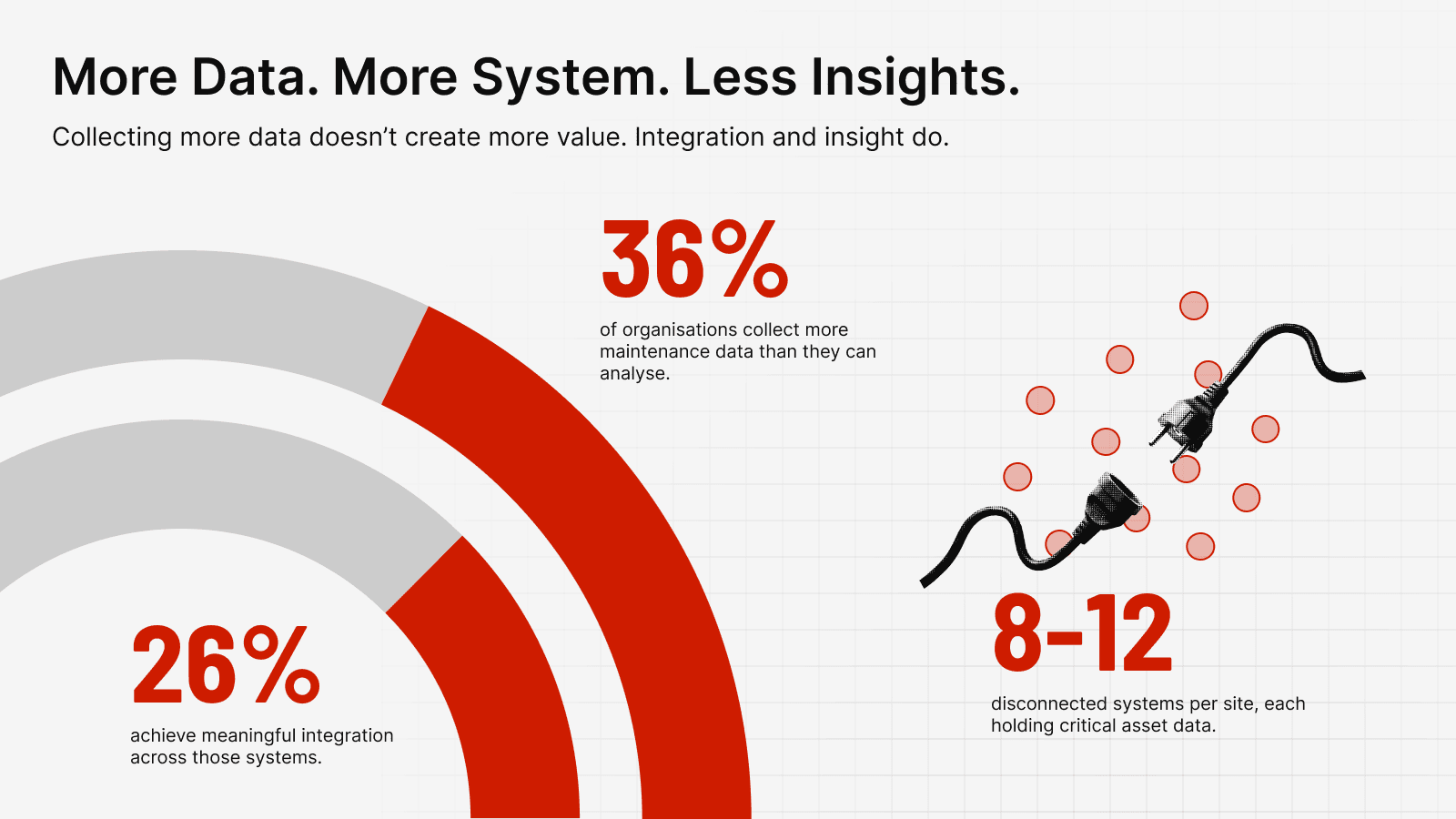
The report is precise on this point. Thirty-six per cent of organisations collect more maintenance data than they can effectively analyse. The average site operates between 8 and 12 disconnected systems containing critical asset information. Only 26 per cent achieve meaningful integration across those systems.
The result is what the report calls a parallel information economy: official records are incomplete and the operational knowledge that actually drives decisions lives in people's heads.
For mining operations, the consequences are not abstract. Maintenance professionals spend an average of 14.6 hours per week searching for, validating, or reconciling data across multiple systems. That is 38 per cent of available work time spent on data administration rather than decisions. At the same time, mean time to repair across Australian industrial operations has increased from 49 to 81 minutes, driven in part by skills gaps but compounded by the time required to locate and verify information before acting on it.
More data has not produced faster, better-informed responses. It has produced more noise, more reconciliation burden, and a workforce increasingly conditioned to distrust the outputs of the systems they are required to use.
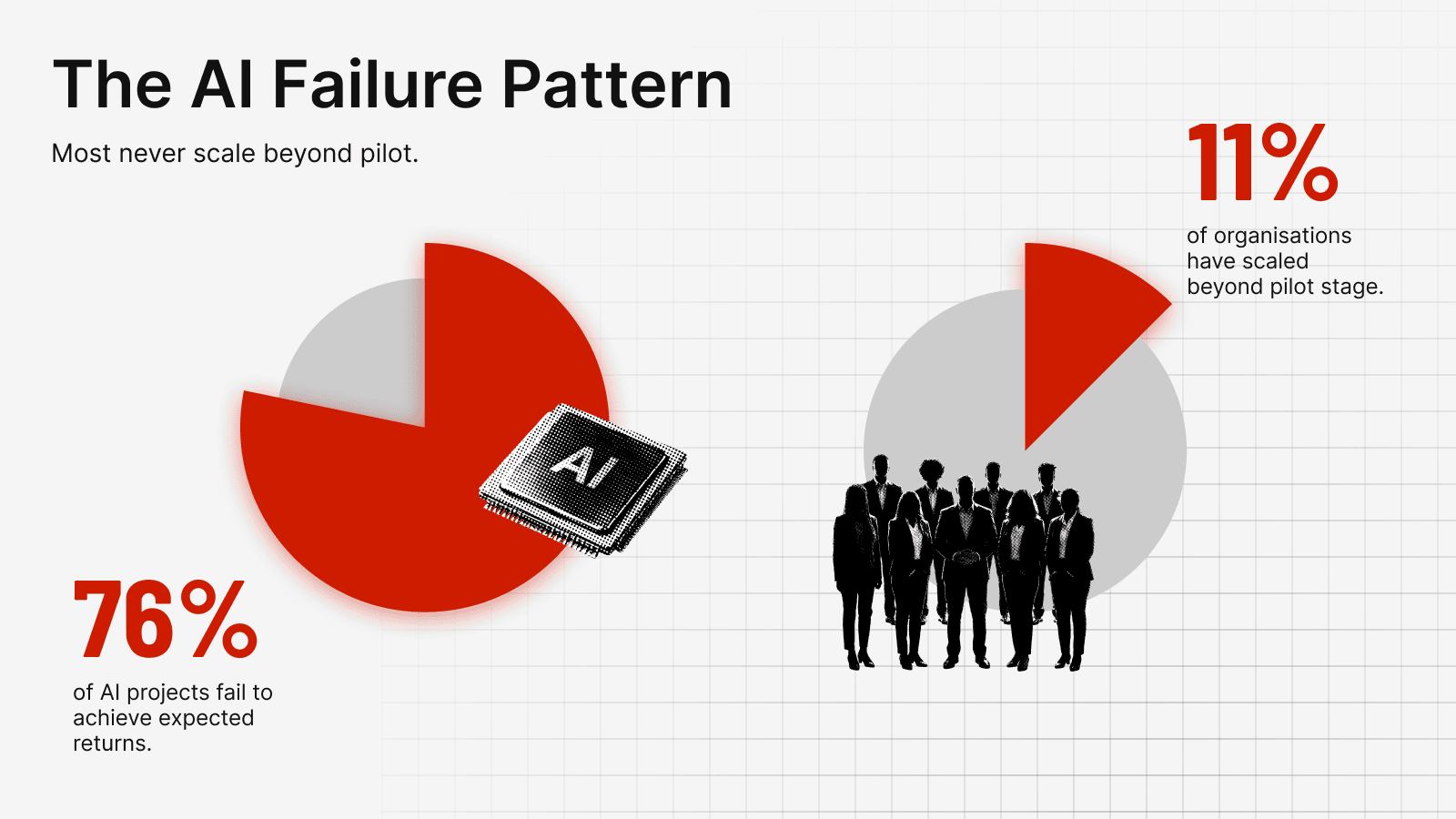
76% of computer vision projects fail to deliver expected returns, and only 11% scale beyond pilot stage.
The AI Failure Pattern Confirms the Root Cause
The report's findings on AI adoption are instructive precisely because they are so consistent with what the data fragmentation findings would predict.
Seventy-six per cent of AI projects fail to achieve expected returns. Only eleven per cent of organisations have scaled beyond pilot stage. The primary barrier is not capability or intent. The report is specific: leadership ambition scores 3.34 out of 5, while workforce AI readiness scores 2.69. The gap is real but not the root issue. The root issue is data.
Pilots work because they operate in controlled environments with dedicated resources and clean inputs. The moment they attempt to scale across operational systems with distributed data quality and inconsistent capture standards, the conditions that made the pilot succeed evaporate.
For mining, this has a concrete financial implication. One iron ore operation cited $2 million per hour in lost revenue during downtime. The organisations in the report with the highest rates of AI pilot failure were not technology-averse. They were data-immature. They invested in analytical capability before they had the data foundations to support it.
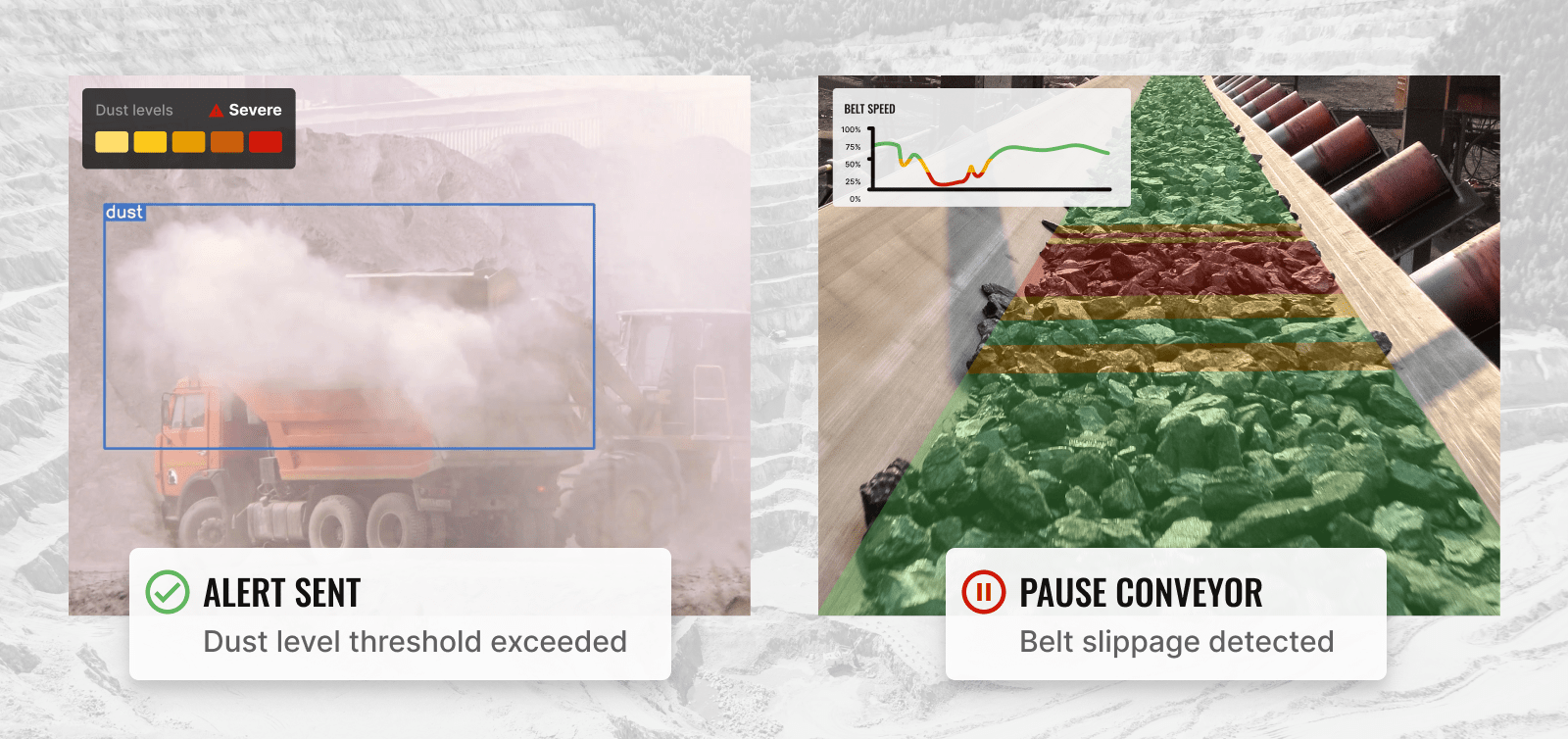
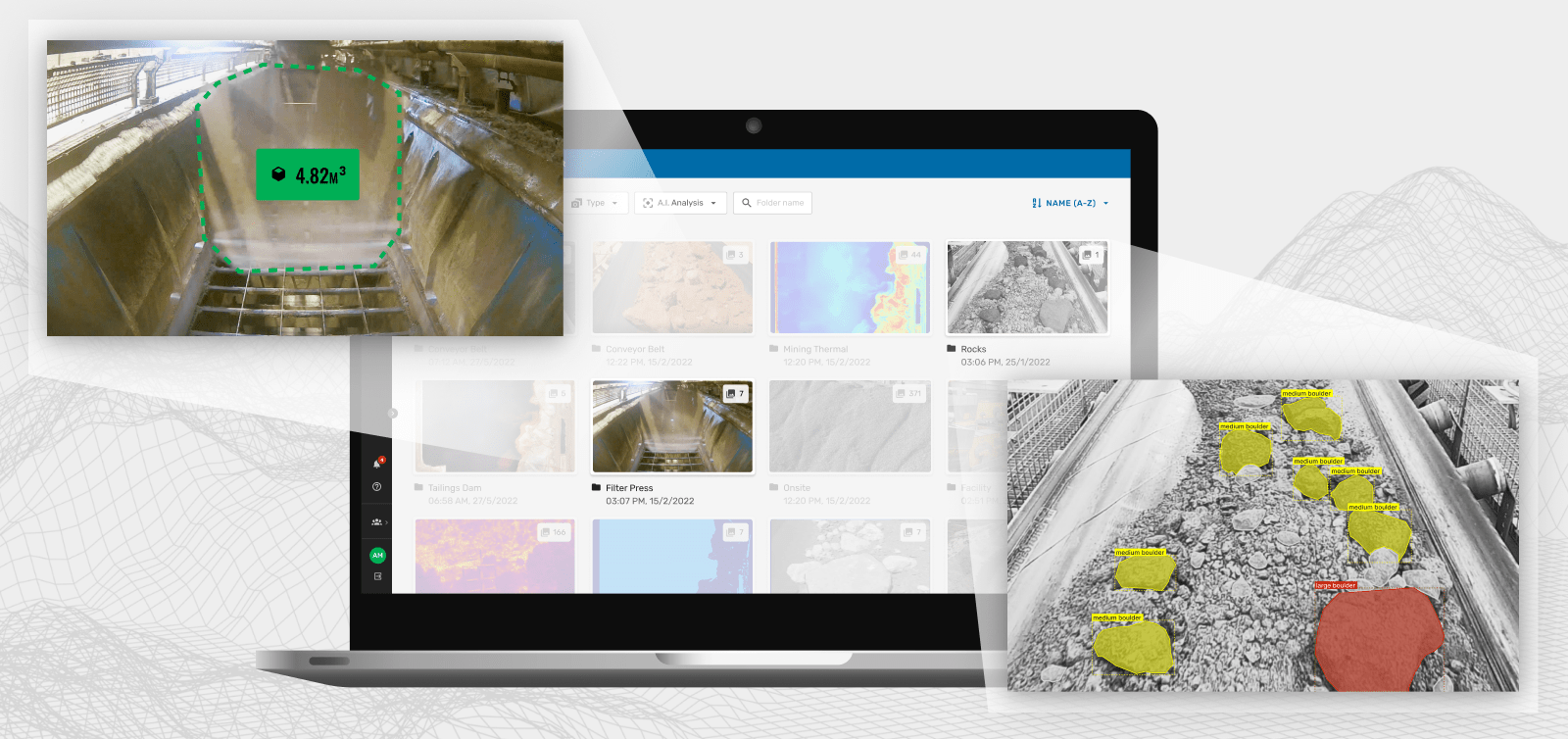
This is a familiar pattern in the monitoring gap. The argument for continuous site monitoring has never been purely about sensors and cameras. It is about whether the visual data those assets generate enters a governed, structured intelligence layer, or accumulates in disconnected repositories that engineers do not trust and executives cannot interrogate.
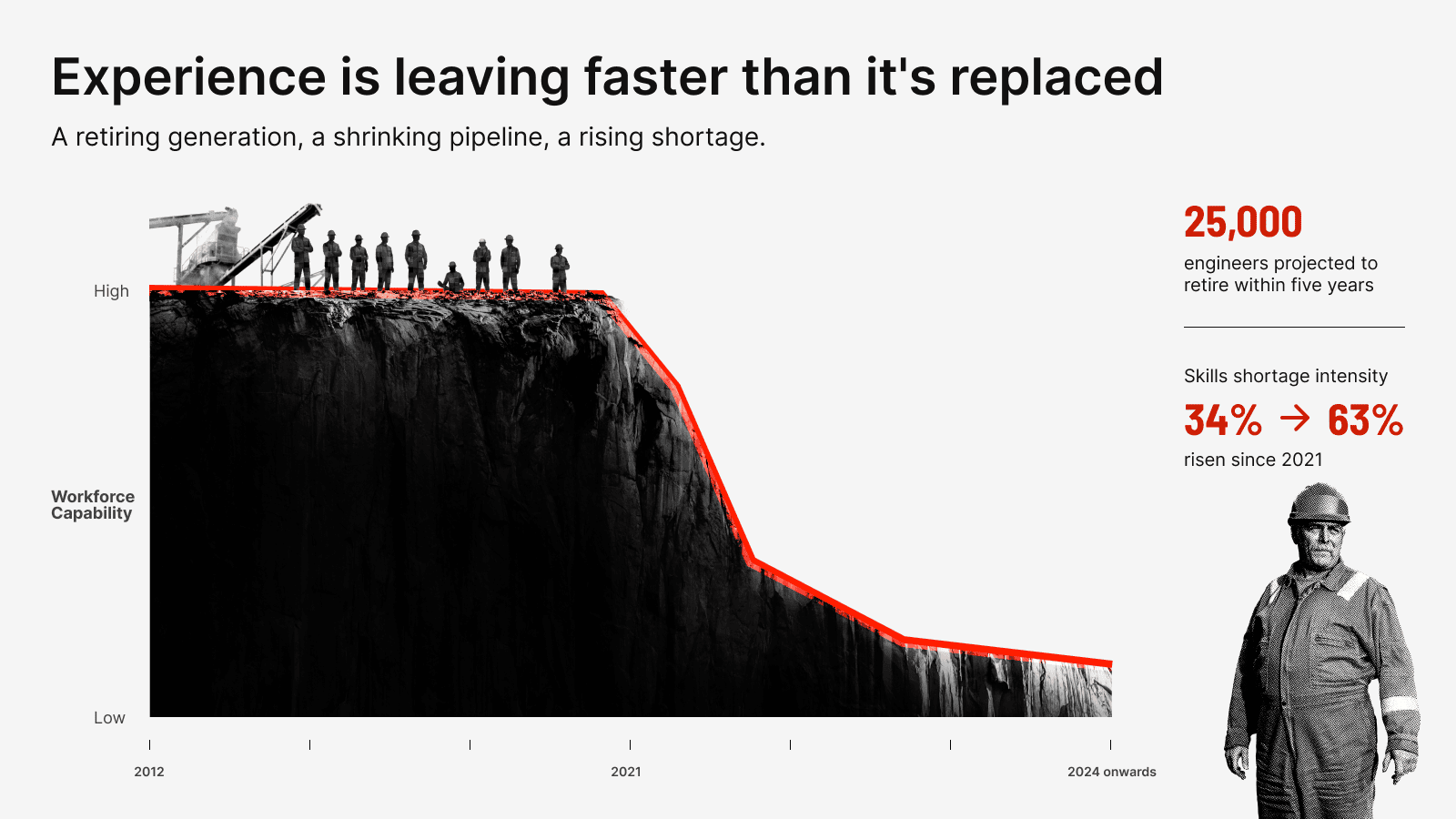
Skills shortage intensity has nearly doubled since 2021, and the pipeline of replacements isn't keeping pace.
The Workforce Pressure Compounds the Problem
The report identifies a workforce transition that directly intersects with the data credibility challenge.
Twenty-five thousand engineers are projected to retire within five years. Mining skills shortage intensity has risen from 34 per cent to 63 per cent since 2021. Apprentice completions have fallen from 485,440 in 2012 to 267,385 in 2024. The knowledge most at risk, the report is explicit on this, is contextual judgement. The engineer who knows what a healthy bearing sounds like. The planner who remembers why a particular supplier's specification failed under specific site conditions fifteen years ago.
That knowledge cannot be documented in a procedure manual. And it cannot be replaced by analytics systems running on fragmented, low-trust data.
What the report describes as the transition from people to systems is only viable if those systems are built on data that can be governed, standardised, and relied upon independent of any individual's institutional knowledge. Where that foundation is absent, the departure of experienced personnel does not just create a skills gap. It creates a capability cliff, because the judgement that compensated for poor data quality leaves with the person.
For mining operations managing sites across multiple geographies, with contractor-dependent workforces and increasing pressure on inspection compliance, this is a critical structural exposure.
What the Report Validates
The MAINSTREAM report was not written with Unleash live's positioning in mind. It was written by practitioners for practitioners, drawing on three decades of longitudinal research. That is precisely why its findings carry commercial weight.
The data trust deficit, system fragmentation, AI pilot failure rate, and workforce knowledge erosion it documents all point to the same structural gap. These organisations are not short of visual data. They are short of governed, trustworthy, actionable intelligence from it.
Capture without governed processing produces archives, not intelligence. Detection without standardised data quality produces alerts that engineers learn to ignore. Analytics without a structured foundation produces pilots that cannot scale.
The 2026 report also confirms a finding that applies directly to how mining operations should be evaluating their monitoring infrastructure. The organisations that are advancing furthest in AI adoption and data capability are not those that invested first in analytical tools. They are those that invested first in data governance, standardised capture, and integration architecture. The analytics followed, because the foundation was there to support it.
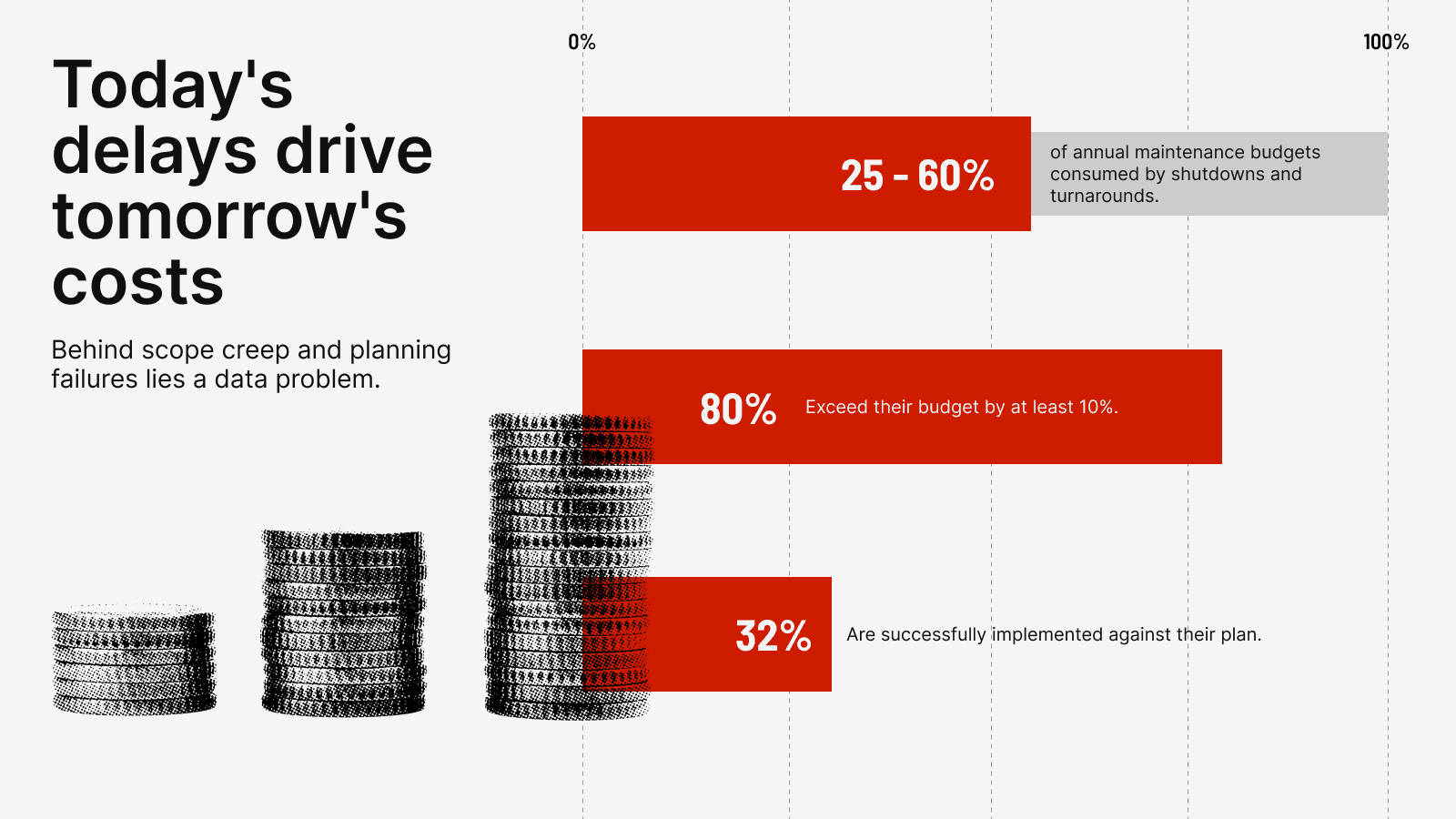
80% of shutdowns exceed budget, and only 32% are delivered against plan.
The Compounding Risk of Inaction
Shutdowns and turnarounds consume between 25 and 60 per cent of annual maintenance budgets across the operations surveyed. 80 per cent exceed their budget by at least 10 per cent. Only 32 per cent are successfully implemented against their plan.
The report attributes this to scope creep, planning failures, and poor contractor management. But running beneath all three is a data problem: conditions that should have been detected earlier were not, because the monitoring architecture between scheduled inspection cycles was absent or inconsistent.
The cost of a single unplanned stoppage on a major mining operation, measured against the operational cost of continuous monitoring infrastructure across a site portfolio, is not a close calculation. It has not been a close calculation for some time. What has changed is that the 2026 report now provides independent validation, from 715 respondents and 153 senior practitioners, that the data credibility and governance gap is the binding constraint on operational performance improvement across the sector.
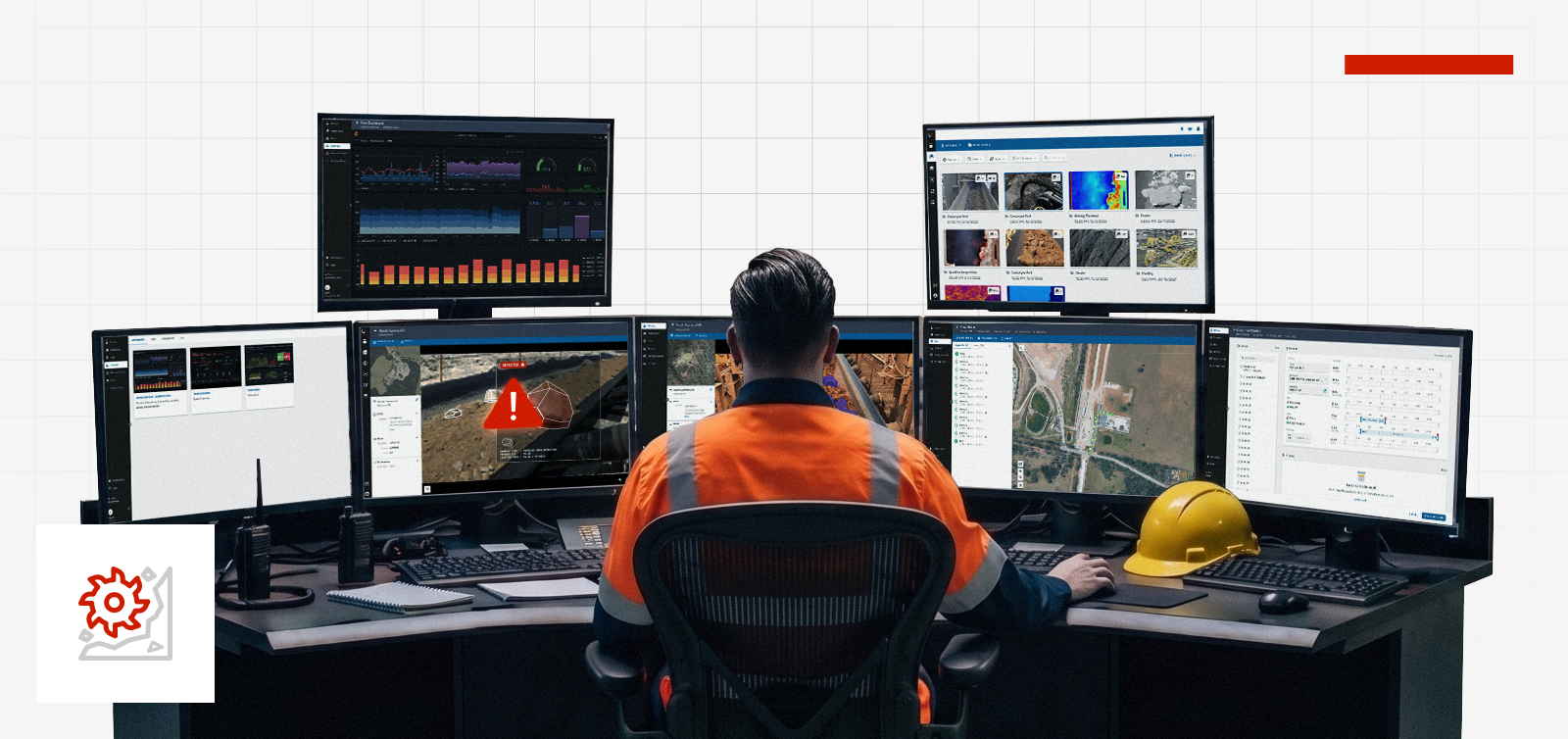
The monitoring gap is not a technology problem waiting for a technology solution. It is a data governance problem that requires a standardized architecture for how visual data is captured, processed, stored, and acted upon, at scale, across sites.
Request an Operational Benchmark Review to assess your current monitoring coverage, data governance posture, and production uptime exposure across your site portfolio.